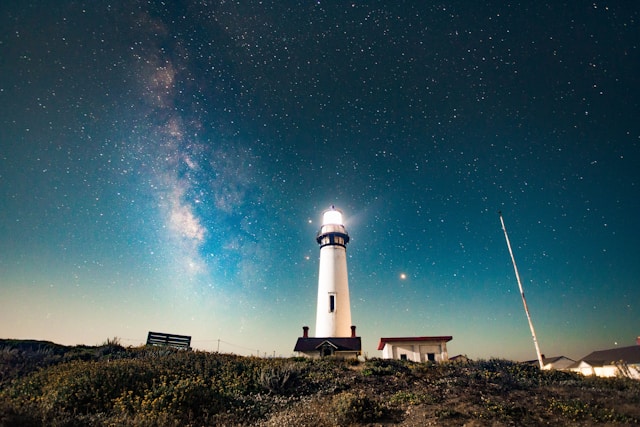
When I walk out of the house at night, I look up at the stars. I’ve done this most of my life. It is still awe inspiring.
We’ve found ways to connect the stars into recognizable shapes in our minds; we give these shapes names like the Big Dipper and Orion.
We tell stories about them.
The stars have led sailors from shore to shore, expanding our awareness and knowledge of our planet, while the shape and glow of the moon lights our surroundings.
Science and satellites have given us a new understanding about their place in the skies. Whether we romanticize them or just see them as configurations of heat and dust, the moon and stars are part of our environment that we are drawn to.
Natural light cycles have defined our days and nights as well as the ecosystems surrounding us for all of known history.
We are especially aware of this beauty surrounding us in Pine Knoll Shores.
As we become more civilized, and with few alarms raised, artificial light has slowly transformed our nights into brightly lit days.
While 24-hour days have led to employment opportunities, reduction in crime, more travel opportunities, etc., current lighting practices have negatively impacted human life as well as the environment.
Artificial light pollution
Light pollution has not been regarded as an important issue until lately. According to the World Atlas of Night Sky Brightness, more than 80% of the world’s population—and 99% of Americans and Europeans—live under a diffuse glow that scatters back from the sky when light is directed upward or is incompletely shielded from the ground.
This sky glow can be visible from great distances, disrupting visibility and jeopardizing our health and our ecosystems.
Light pollution in all of its forms disrupts the natural circadian rhythms of living organisms.
Exposure to artificial light at night can interfere with the production of melatonin, which can lead to sleep disorders, mood disorders, obesity, diabetes, cardiovascular diseases and some cancers.
Light pollution affects the behavior and survival of wildlife, especially nocturnal animals that rely on darkness for hunting, foraging, migration, reproduction and communication.
Artificial light can attract, repel, confuse or blind animals, making them more vulnerable to predators, competitors or human activities.
Light pollution affects the growth cycle of plants as well as their pollinators. In addition, when used indiscriminately, artificial light wastes money and energy and is believed to contribute to climate change.
Bring back the dark sky
There are several organizations working to reduce light pollution. One of these is the U.S.-based International Dark Sky Association (IDA), formed in 1988 to preserve the natural night sky.
IDA educates the public and certifies parks and other places that have worked to reduce their light emissions.
It is worth noting that the Carteret County Board of Commissioners endorsed a Dark Skies resolution, and the application, for certification of Cape Lookout National Seashore as an International Dark Sky Park was successfully completed in December 2021.
It is the first certified Dark Sky Place on the east coast.
Currently, a resolution is before the Pine Knoll Shores Board of Commissioners asking for guidance and assurances that responsible outdoor lighting practices are in place.
These include the use of shielded fixtures, low-intensity lighting and efficient technologies that minimize light spill and glare.
These tools help preserve the integrity of the night sky while ensuring public safety and security.
The commissioners have asked the Planning Board to look into measures to promote low-intensity lighting, etc. and report on their findings.
This opens a discussion in the community on light pollution, why we need to reduce it and simple ways to accomplish this.
This effort is not about telling people they have to turn off all outside lights at night or that all outside lighting must be replaced. This is not about politics. It is about our quality of life.
This resolution is consistent with our town’s heritage:
- Alice Hoffman, an early resident and land owner on Bogue Banks, was a conservationist in the way she managed her property that later provided the foundation land for the development of Pine Knoll Shores by her heirs (the Roosevelt Trust).
- We are a recognized Tree City, respecting the maritime forest and trees growing in residential development spaces as well as a turtle sanctuary with regulations defining areas along ocean-facing nesting habitats for sea turtles;
- The resolution acknowledges that the detrimental effects of light pollution extend beyond maritime forests and trees and nesting sea turtles to the broader quality of island life by impacting human health, public safety, astronomical observations, energy security and global climate.
I encourage you to support a light management plan that will reduce light pollution and preserve the integrity of our valued natural ecosystems through advocacy, education and the proper application of lighting principles.
Let me and/or our town officials know your thoughts.
While the Dark Sky principles are consistent with our community’s interest and definition, we are not asking for certification.
Sources: DarkSky.org; Dark Sky International with the Illuminating Engineering Society (9/2023); EarthEclipse.com; Carteret County Board of Commissioners, regular session, Sept. 21, 2020.